
Everyone is talking about AI.
Incredible reports. Incredible predictions. Incredible dashboards that show you the future of your business before breakfast.
And it is true. AI can do remarkable things. But nobody is talking about what actually makes it fail, not technically, not in theory, but in practice, inside companies like yours.
AI needs data. Real data. Clean, structured data from your actual operations. And it needs context: who does what, where information flows, how one process connects to the next.
Without that, you have hired the smartest person in the world and put them in a room with no windows, no documents, and no idea who they are supposed to be working with.
That is not an AI problem. That is a foundation problem.
The part nobody mentions
The conversation around AI in business tends to go one of two ways.
Either it is breathless enthusiasm: AI will automate everything, summarize everything, predict everything, do everything faster and cheaper and smarter than humans ever could.
Or it is breathless skepticism: AI is overhyped, it hallucinates, it cannot be trusted with anything that matters.
Both conversations miss the point.
The question is not whether AI is capable. It is whether your business is ready to use it. And most businesses are not — not because they lack access to AI tools, but because they lack the one thing AI actually runs on: organized, accurate, connected data about how the business actually works.
If your operations live in disconnected spreadsheets, your customer data is in one place and your invoices are in another and your inventory is managed by someone who knows where everything is but has never written it down, you do not have a data problem. You have a foundation problem.
And no AI tool fixes that for you.
What "foundation" actually means
A foundation, in this context, is not a data warehouse or a business intelligence platform. It is simpler than that.
It is a system that captures what your business actually does, in real time, in a structured way. Who placed an order. What was delivered. What was invoiced. What the margin was. Which client complained and why. Which team member handled it and how long it took.
When those things are captured consistently, in one place, connected to each other, something remarkable happens: the business becomes legible. Not just to a CEO reviewing a monthly report, but to any analytical tool you might want to apply to it, including AI.
That is what makes AI useful in an operational context. Not its raw intelligence, but the quality of the data it has access to. AI operating on good operational data can surface patterns you would never find manually. It can flag an anomaly before it becomes a problem. It can answer a question in seconds that used to take two days to prepare.
AI operating on fragmented, inconsistent, manually assembled data mostly produces confident-sounding answers that are quietly wrong.
Why this matters right now
The businesses that will get the most out of AI in the next three years are not the ones that adopt AI first. They are the ones that build the right foundation first.
The irony is that most companies are running the process backwards. They are looking for AI tools to solve operational problems before they have the operational infrastructure that makes those tools work.
It is not a technology mistake. It is a sequencing mistake.
You do not need a predictive analytics engine if you do not have a reliable way to capture what is happening in your business today. You do not need an AI assistant that summarizes your operations if those operations live in five different spreadsheets maintained by five different people who each have their own version of the truth.
The companies that understand this are not waiting for AI to get smarter. They are building a foundation now, so that when AI is applied to their business, it actually has something real to work with.
What we built YUBA for
This is the reason YUBA exists.
Not to check a digitalization box. Not to give you a dashboard you look at once a quarter. But to give your business, and eventually every analytical tool you apply to it, what it actually needs: real data from real operations, organized in a way that creates genuine context.
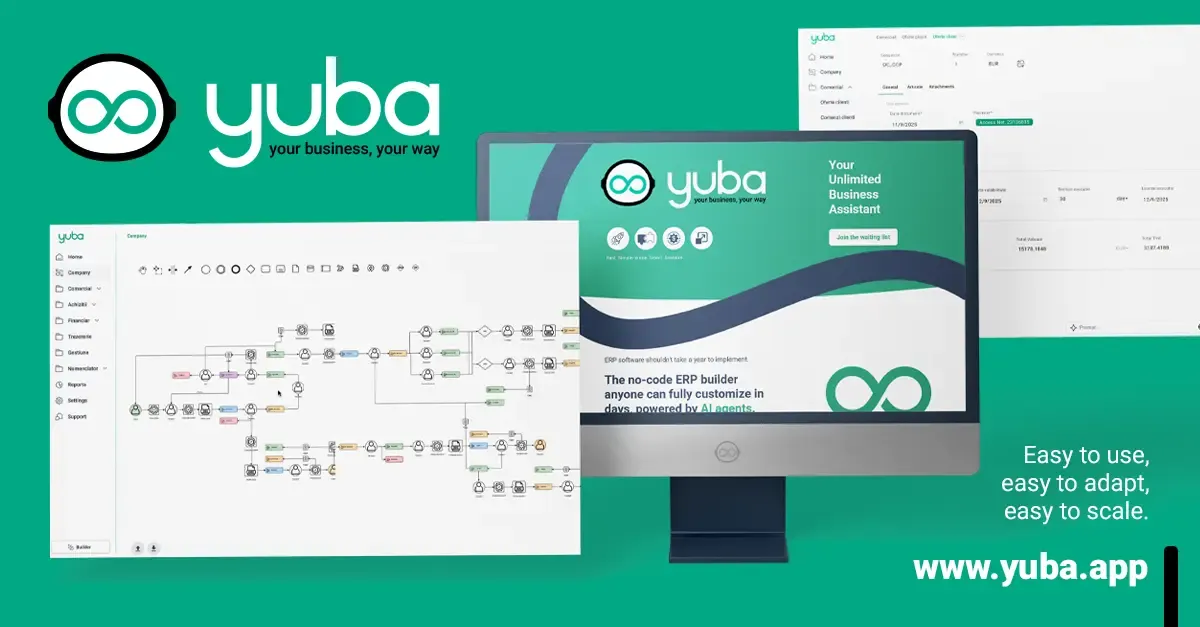
When a business runs on YUBA, it captures what is happening across sales, operations, inventory, and finance in a connected, structured way. Every process leaves a trace. Every trace becomes data. Every piece of data is connected to the process that generated it.
That is what makes AI actually useful at the operational level. Not intelligence layered on top of chaos. Intelligence applied to clarity.
We built YUBA for businesses that want to get there without a twelve-month implementation project or a team of developers. You are operational in weeks. The data starts accumulating from day one.
By the time you are ready to apply AI to your business, you will have something real to give it.
Before you ask what AI can do for your business, ask what your business can give AI to work with.
If the answer is disconnected spreadsheets, manual processes, and data that lives in people's heads, start there. Not with AI.
Build the foundation. The AI will follow.
If you want to see what that looks like for your specific business, let's talk.